Maragoli Hills – a 1000-acre degraded mountain ecosystem in western Kenya. Once a thriving water catchment, the Hills were reduced to bare rocks, due to deforestation that left the soil bare and subject to erosion. Rehabilitation of Maragoli Hills has seen several failed attempts by government agencies and NGOs, largely because the local community was left out of the loop. With the community on board, the project has gained momentum, spelling hope for the residents.
Communities in Vihiga County of Western Kenya have suffered from effects of climate change across the sectors. Perhaps the worst hit has been the agriculture sector around Maragoli Hills, a once thriving ecosystem that was the source of several streams flowing down to Lake Victoria. Due to massive deforestation of the Hills, combined with climate change, rainfall patterns have shifted greatly, with seasons becoming unpredictable, and crop failure has become common phenomena.
The Maragoli Hills form a dominant environmental feature in Vihiga County, Kenya. Until the early 1990s, the Maragoli Hills were a healthy natural forest and water tower, rich in biodiversity and a source of many springs and streams flowing down into rivers and finally into Lake Victoria. In the years leading to 2000, a lot of destruction occurred in the forest, largely due to compromised administrators and pressure from local communities for firewood, timber and land for agriculture. Today, the badly degraded Maragoli Hills Ecosystem covers an expanse of 1000-acres of near-bare rocks.
Part of the features in the Hills are the Mungoma caves, which were a popular attraction to both local and international tourists, with the hill-tops in the ecosystem offering panoramic scenic viewpoints for bird watching and hiking, the Nandi Hills, Miwani Plains, Ndere and Maboko Islands on Lake Victoria. On the other end of the Hills stand Bunyore Shrine, considered the home of the ancestors of the Bunyore sub-tribe who are predominant in Luanda Sub-County.
In the last 2 decades, there have been numerous interventions by different stakeholders to restore the ecosystem of hills, but most of them yielded limited results. Such stakeholders included both civil society organizations and government agencies such as the Kenya Forest Service. A number of reasons constrained these efforts – including:
Inadequate Consultation and Involvement of the Local Community – there wasn’t adequate involvement of the local community, to the extent that they only got involved at the implementation stage. This led to hostility against the interventions, and little could be achieved in the long-term.
Tree Planting instead of Tree Growing - after-care activities for trees were not considered in the planning. Practices such as weeding, protection against any forms of damage and watering were not taken into consideration – leading to low survival of trees.
Land Ownership Disputes – individuals in the local community claimed ownership of some sections of the hills, and demanded compensation if they were to release their land for rehabilitation. The government on the other hand held that some title deeds had been acquired irregularly, hence most of the claims by those who resided within the gazetted Maragoli hills ecosystem could not hold, and evictions were inevitable. This fuelled hostility and resistance between the community and government.
Disputes on Species of Trees to Grow - the government and other stakeholders proposed planting indigenous tree species to rehabilitate the hills, but families within and around the hills insisted only fruit trees (such as mangoes, papaws and avocadoes could be grown.
Climate change has further aggravated the situation, with many streams flowing from the hills drying up during prolonged droughts, and flash-floods being experienced in the down-stream parts, such as the out-skirts of Kisumu city.
THE COMMUNITY-LED INTERVENTIONS:
It’s against this backdrop of failed restoration efforts that the Maragoli Hills Water Resource Users’ Association (MAHIWRUA) has mobilized other stakeholders within the ecosystem to collaboratively champion interventions that will see the Hills brought back to their ecological integrity and functions. To this end, local faith-based organizations and other CBOs have held consultative meetings, and invited forestry experts to train them on good practices in tree growing. The forestry department at the County government is actively supporting this initiative with technical advice, as well as donations of tree seedlings for planting by the local community, including fruit trees on their farms.
This has led to some positive results, with 85% survival of 40,000 trees planted in May 2021. In order to provide security, the County government has also put up an office facility within the ecosystem to coordinate restoration activities, with a working desk for MAHIWRUA. The association is also promoting on-farm forestry as part of the strategy to promote tree growing by the community and thus easing pressure on the natural gazetted forests.
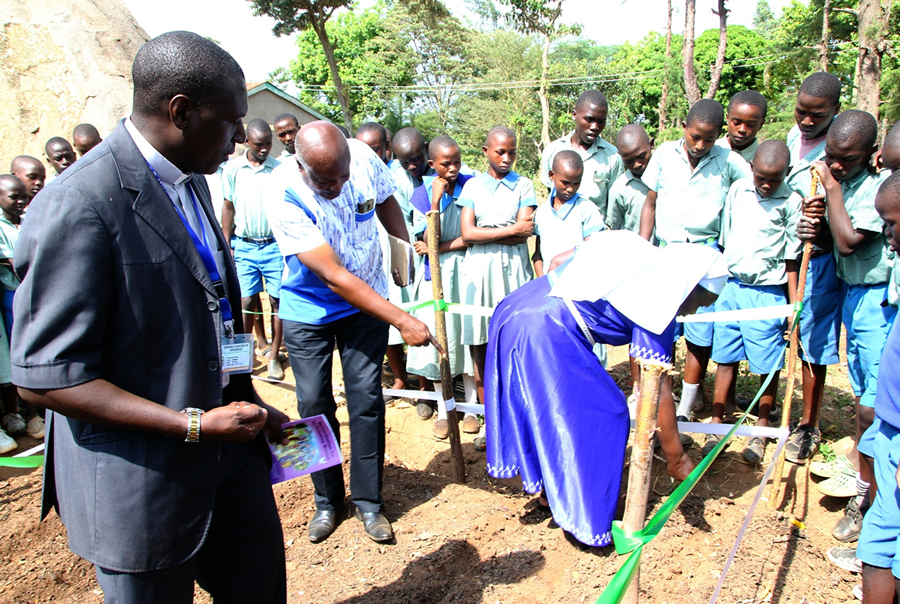
Learners from schools around Maragoli hills are involved in the initiative.
One of the key partners in the initiative is the Catholic Diocese of Kakamega – under the Catholic Justice and Peace Department (CJPD)- which is helping coordinate other faith actors in engaging actively.
Members of the local community are being encouraged to establish and manage tree nurseries, from which seedlings for rehabilitation will be bought, thereby serving as a source of income to them. Groups from the local community are also being trained in various aspects such planting, care and protection of trees.
In order to support livelihoods and further motivate the community to remain engaged in the initiative, local community groups have been allowed access to practice bee-keeping in the upcoming forest, with some groups already having received some donations of bee-hives.
LESSONS FROM THE PROJECT:
Involvement of local communities in restoration initiatives is an essential component for success – and should not be at the tail end, but right from inception and throughout the project cycle. The case of Maragoli Hills is a classic example where the community had remained a spectator, seeing NGOs and state agencies planting trees on land they considered theirs. In several successive plantings, the very community members uprooted or grazed down the trees, and no amount of protection could save the trees.
Further collaborative effort in the last few years has seen notable success in restoring the hills. Public-private-partnerships have meant synergies created, resources pooled together, and knowledge and skills shared among partners. The private sector, especially the local banks such as Kenya Commercial bank and Equity bank, have been instrumental in donation of tree seedlings while the CBOs provided labour for the entire tree growing cycle.
With the on-going efforts, there is hope that the hills will finally be rehabilitated, and the springs and streams revived, with accompanying benefits to people, nature and climate.
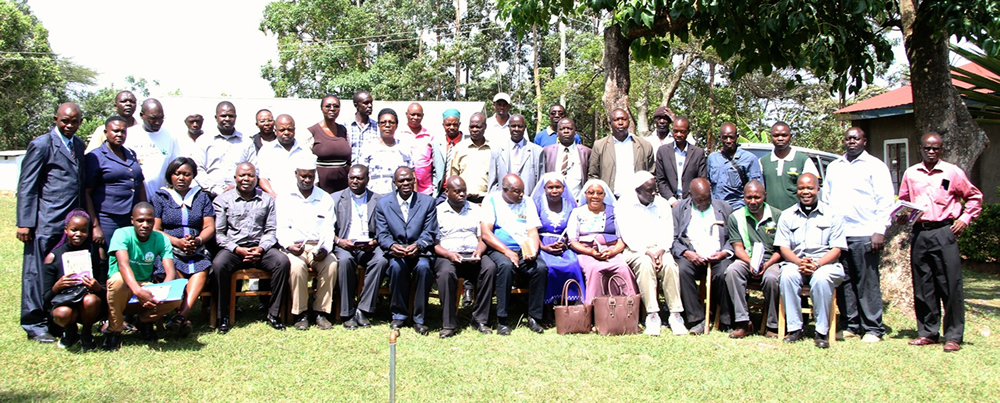
A group photo of MAHIWRUA members with other stakeholders at the Maragoli Hills
Author: Tom Barasa Wafula, National Technical Support Expert - Kenya NDF
NBD reached significant achievements in the year 2022, through leveraging platforms for cooperation on the Nile, engaging young professionals, mobilizing flood prone grassroots communities, mobilizing grassroots women to form networks, and engaging the National Nile Discourse Forums (NDFs) on capacity building and sustainability.
NBD leveraged various platforms to fulfil the mandate to communicate benefits of Nile cooperation and risks of non-cooperation. These include: the Regional Nile Day 2022 celebrations, the Nile-COM meetings, the World Water Week, and the COP27 conference.
To expedite NBD’s outreach programmes and knowledge sharing, NBD ran a pilot youth internship programme in the Eastern Nile Basin Countries. The programme recruited young university graduates to closely work with NDFs in Egypt, Ethiopia, South Sudan, and Sudan; collecting real-time data and information on the priorities and concerns of grassroots women and youth mainly focusing on the NBD-NCCR project thematic area 2: Flood and Drought Risk Mitigation.
In order to amplify the voices of flood affected grassroots communities in the policy-making processes of governments and inter-governmental agencies such as NBI, NBD mobilized flood prone grassroots communities in Ethiopia and Sudan to interact with experts from both governments of the two countries and NBI’s NELSAP-CU.
Additionally, NBD mobilized grassroots women in member countries to establish fit-for-purpose networks at both national and regional levels. The networks will play key roles in effective uptake and sustainability of the NCCR project outcomes, and serve as a regional Task Force working with NBD and NBI on issues related to water and Women in line with the NBI Gender Mainstreaming Strategy.
During the fiscal year, NBD effectively liaised with and technically supported NDFs to mobilize stakeholders to inform the NCCR project especially flood-prone communities, recruiting young interns, formation of grassroots women networks, and in preparing monthly User Generated Content (UGC).
Aside the NCCR project context, NBD registered two achievements: (i) NBD became a member of the Pan African Climate Justice Alliance (PACJA), a status that gives NBD the opportunity to participate in the African civil society platform on climate change and sustainable development; and (ii) NBD secured a small seed funding from GIZ via Women for Water Partnership (WfWP) and implemented the project in collaboration with Community Initiative for Transformative Action-Uganda (CITA-Uganda) - a member of the Uganda NDF.
ADHENO Integrated Rural Development Association has been implementing Integrated Environmental Rehabilitation and Livelihood Improvement Projects in Baso Na Worena Woreda, Amhara Region, Ethiopia. The main goal is to improve livelihoods of the rural communities through environmental rehabilitation and improving agricultural production. The projects mainly target the North Shewa zone of Amhara region in Ethiopia. Tested solutions, and lessons learned and documented during the project implementation are presented for lesson dissemination and future programing.
Basona Worena is one of the Woredas in the Amhara region; located in the eastern edge of the Ethiopian highlands in the North Showa Zone. Its altitude ranges from 1300–3,700 MASL and is largely mountainous with escarpments covered predominantly with reddish-brown soil. The Woreda receives monomodal rain whereas some parts receive bimodal rainfall. Climatologically, there are four zones i.e. Wurch 2%, highland 50%, midland 46% and lowland 2%.
The livelihoods of Smallholder farmers in the target kebeles mainly depend on crop cultivation and domestic animal rearing. Most households’ energy supply depends on biomass such as fuel wood, charcoal, farming residues and dung. Communities are practicing unwise use of natural resources for their livelihoods that are largely at risk to detrimental impacts of climate change.
In target Kebeles, spring crop production (“Belg” season) has been completely stopped for 30 years due to climate change impacts. As a result, communities have been pushed to live below the poverty line; whatever efforts they have exerted to produce sufficient crop production in the winter (June – August), their productivity remained low because the soil-type of the area is not compatible to summer season production. The excessive rainfall creates swampy and muddy landscape which does not allow crop production, thus there is no productive agricultural activity in the winter season.
Recurrent drought and locust infestation are additional challenges that affected agriculture production in the project area. The drought situation worsened by climate change impacts coupled with natural resource degradation further reduced the small holder farmers' agricultural yield.
Land degradation and soil infertility has also been impacting agricultural productivity by reducing crop production and causing considerable social and economic losses. Lack of alternative means of livelihood and full dependency on traditional farming that doesn’t cover house holds' basic requirements is also a major development challenge of the project area. Climate reliability has been deteriorating over time due to deforestation and cutting of trees for arable land, firewood, charcoal and construction. This has resulted in environmental degradation, food insecurity and extreme poverty in various forms.
The Interventions:
ADHENO Integrated Rural Development Association - a member NGO of the Ethiopia Nile Discourse Forum has been implementing an Integrated Environmental Rehabilitation and Livelihoods Improvement Project in Baso Na Worena Woreda since the year 2020 with generous support from All We Can and Dir Biaber. The project's overall goal is to improve the livelihoods of the rural communities through environmental rehabilitation and improving agricultural production. The project targeted a total of 6,423 direct beneficiaries of which 2,520 are females and about 32,150 indirect beneficiaries live within Woynye, Goshebado, Metkorya, Moy Amanguilt, and Muti Cherkos kebeles of Baso Na Worena Woreda, in North Shewa zone of Amhara region.
Community Based Organizations are important entry points to targeted communities. With regards to partnership, special emphasis is given to “Idir” (an informal social group organized to deal with social issues). ADHENO has thus provided technical and material support to one “Idir” operating in the area. Members of this “Idir” are now active partners of the project specifically on promoting the theme of the project; "Propagating the cultural heritage and biodiversity conservation". They play key role in mobilizing the community for annual tree planting, protecting area closures, as well as planting local Variety of seeds, fruits and vegetables, and contribute the incentives from their participation in Tree Gudifecha towards their institutional strength.
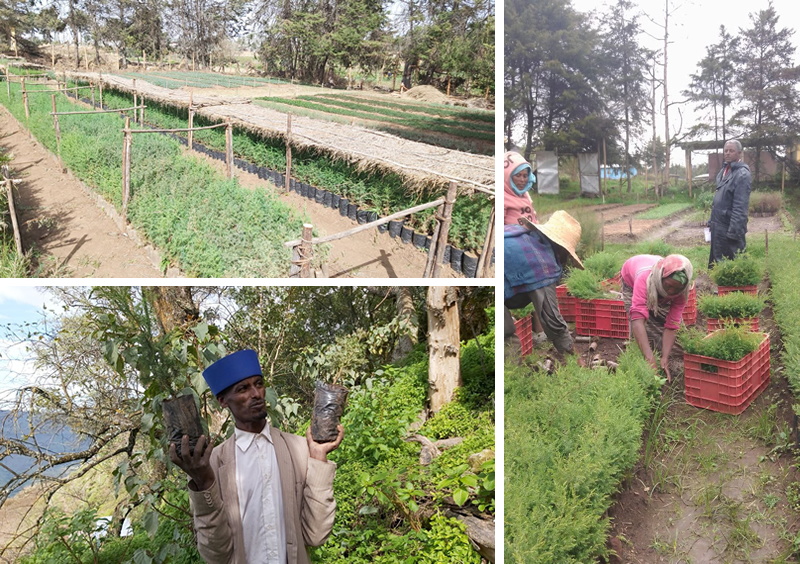
Distribution of mainly native tree seedlings from the established tree nurseries.
The organization came up with an innovative approach called Tree “Gudifecha” to effectively address land degradation. This involved establishing tree nursery sites, tree planting, and forest development and management. Each year, a significant number of tree seedlings were raised and planted in designated closed areas. Farmers have been planting both indigenous and exotic trees and these trees are currently restoring the degraded land - changing it into forest area.
The program facilitated training on natural resource management, supported farmers with farm tools, and mobilized the community to do physical and biological structures which were constructed on degraded farm land. The program supported the rehabilitation of hundreds of hectares of degraded land and made it productive. The program supported the biodiversity and indigenous forest conservation by providing material and technical assistance to target communities and local churches. As a result, vegetation coverage in the project area has tremendously increased.
For such impactful and highly sustainable projects, ADHENO received an award from H.E. Girma Wolde-Giorgis (the former President of Ethiopia) as a ‘Green Hero’ for its innovative approach of Tree Gudifecha concept; a new approach that encourages and motivates farmers to plant and care for trees much like they would to an adopted child. The organization has demonstrated the effectiveness of this approach by closely working with various communities in North Shewa in planting and caring for hundreds of thousands of indigenous trees, resulting in the visible greening of the landscape and recovery of barren lands. The project has forged close partnership with the community in merging indigenous local traditional approaches to resource management with modern concepts of conservation and sound agro-economic principles. In addition, the project builds on over a thousand years of local Christian tradition of reverence for trees around churches through focused efforts aimed at resuscitating native species in specially designated area enclosures around churches. Given the alarming rate of deforestation and desertification in Ethiopia, and the associated falling of agricultural yields, Gudifetcha of Trees is especially critical in ensuring that the land recovers some of its productivity.
The program leverages traditional practices of planting trees around church compounds and closely works with community groups not only to rehabilitate their environment but also address their pressing economic needs in a way that preserves their culture, tradition, and environment. This clearly indicates that the organization was able to build credible partnerships with local the communities and line government offices without whose approval, none of these projects could be implemented.
The project gives emphasis to gender equality and women economic empowerment. Women were trained on business skills and organized into Women Self-Help Groups which resulted in increased communication, social skills, and saving and credit practices among women. The women received support to start their own businesses that that generate additional income.
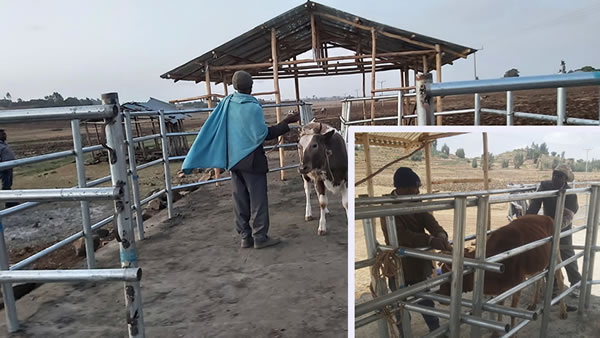
The veterinary veterinary breeding and treatment center established by the project; In-set, A livestock support personnel administers AI to a cow.
To address food insecurity, the program has given different capacity building training on livestock & poultry management, and improved potato and other horticulture production. It has also provided improved breeds of heifers; improved potato and cereal seeds; and improved chicken breeds among others.
As a result of intensive training and experience sharing events, Artificial Insemination (AI) services were found to be the most effective breeding process. To this end, a state-of-the-art veterinary breeding and treatment center - the first of its kind in that community, has been constructed and is already in operation. In 2021 and 2022, 23 improved breeds of heifers were distributed to economically deprived farmers with a cost-sharing scheme where farmers contributed 5% of the total price of a heifer. These heifers have become the first of their kind in the area and have become a symbol of hope and inspiration for the community. Some of the heifers have given birth and farmers are getting sufficient milk production which serves for both household consumption and sales.
Another successful activity in the target kebeles is the provision of improved potato seeds to farmers. Providing improved potato seeds to farmers in the project implementation area was found very essential in ensuring food security. It was realized that this improved potato breed starts giving production in the winter season which is the most food-insecure season of the year by which most households would have run out of food stocks.
Milestones, observations and Lessons Learned:
The innovative approach called Tree “Gudifecha” motivated the communities to plant and care for indigenous trees. The approach also supported creating awareness on the benefits of conserving indigenous forests and ownership of the resources for environmental rehabilitation.
ADHENO has strong partnership with local churches in promoting indigenous forest conservation and mobilizing the community for the cause.
The organization undertakes local resource mobilization by closely working with the local churches in supporting its development programs that provides benefits for the local community.
Environmental rehabilitation is a long term project and challenging for the community. For poor communities like the ones ADHENO is operating in, it is essential to include income generating activities with rehabilitation of natural resources.
Through training and experience-sharing events on modern animal husbandry, it has been possible to increase the consciousness of the society and change the traditional and ineffective breeding methods in the community.
Being focused on specific areas of intervention and geographic locations helped to implement various projects at a time with limited budget and limited human capital.
ADHENO works closely with line government offices and utilizes available resources such as improved seeds, motorcycles and available expertise.
Moreover, provision of intensive training and undertaking extensive experience sharing events helps to make project activities effective during implementation. They also contribute to the ease of the work by half.
The last but not least lesson learnt is commitment and collaboration of staff members which helps to implement projects successfully.
The vision and the values that founders set during the establishment of the organization played a significant role in sustaining it for years. Different effective and efficient projects were implemented with limited budgets and a few human resource.
ADHENO Integrated Rural Development Association is an Ethiopian grassroots Non-Governmental Organization (NGO) established in 2002 G.C. ADHENO is a member of NBD - subscribing through the Ethiopian Nile Discourse Forum. The organisation envisions healthy, socially and economically empowered, and self-sufficient rural people with sustained livelihoods. Since its establishment, ADHENO has developed and successfully implemented more than four (4) strategic plans with thematic areas: integrated environmental rehabilitation, biodiversity, education, WASH, and economic empowerment in different communities of Basso Na Worena District. Contact: Mr. Yonathan Fikre (Executive Director), Tel: +251116635080, E-mail: This email address is being protected from spambots. You need JavaScript enabled to view it.
Author: Michael John Hartley, National Technical Support Expert - Ethiopia NDF