TPL_YOOTHEME_SKIP_TO_MAIN_CONTENT
Some of the participants at the National Tree Day 2022 event in Bunia, Ituri Province. Each of them planted a tree in celebration of the day.

Working with communities to repulse deforestation through afforestation; CSOs for climate change action in the Ituri province of Eastern DRC

On 5th December, 2022, DRC celebrated the National Tree Day under the theme "Technical Reforestation Routes: Role of a Tree in the School Environment".    A consortium of 25 civil society organizations working on environmental protection within Ituri Province organized a community sensitisation and action event on the effects of deforestation and its contribution to climate change,  and fostering afforestation as the immediate action to repulse the effects.
It is estimated that between 2002 and 2021, Ituri province in DRC lost 297,000 hectares of humid primary forests, which represents 66% of its total Tree Cover Loss during the same period.  The total area of wet primary forests in Ituri decreased by 7.5% during this period.  From 2001 to 2021, Ituri lost 463,000 hectares of plant cover, which is equivalent to a decrease of 8.2% of the plant cover since 2000, and 339MT of C02 emissions.

Lately, Ituri has high occurrence of forest fires with 266 alerts reported between December 2021 and December 2022 which is even relatively low compared to previous years as far as 2012. Between the years 2001 and 2021, Ituri lost 77ha of tree cover due to fires and 463kha due to all other factors.

On the 5th of December each year, DRC celebrates the National Tree Day, a day to commemorate the importance of trees for DRC’s economy, society and environment. This is intended to remind citizens that the country’s future is tied to biodiversity and strength of its forests. For the year 2022, the day was celebrated under the theme: "Technical Reforestation Routes: Role of a Tree in the School Environment". In Ituri province, FLEVICA - a civil society organisation and a member of the Nile Basin Discourse (NBD) through the DRC Nile Discourse Forum (NDF), with support from TROCAIRE led a consortium of 25 Civil Society Organizations working on environmental protection and organized a community environment sensitisation event to mark the DRC National Tree Day.
The event drew a wide number of participants including representatives from both the local and central governments, learners and staff of academic institutions in the area, and the community at large.

At the event, participants were sensitised on the topic of deforestation, its effects on climate change, and  the benefits of reforestation to the ecosystem and the environment. Participants were equipped to become ambassadors and trainers of their communities in reforestation as the best means to repulse deforestation.
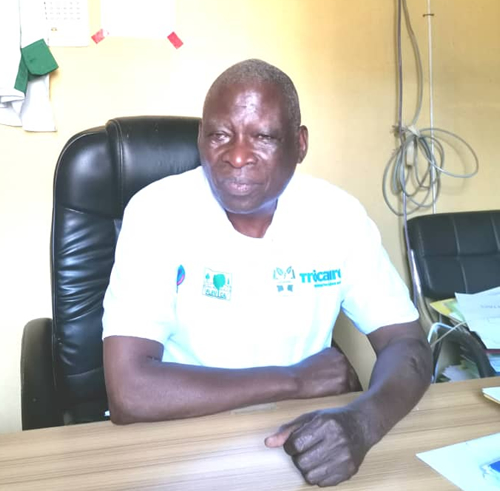
Mr. Ukelo Jonathan, Chairperson - FLEVICA
Mr. Ukelo Jonathan at FLEVICA office in Bunia
According to Mr. Ukelo Jonathan - Chairperson of FLEVICA, the challenge of deforestation is enormous in the province of Ituri and that’s why civil society is commemorating this day in collaboration with educational institutions and political authorities in order to raise massive awareness on the dangers of deforestation but also catalyze action against it through popularizing reforestation. The threat of climate change is already here; a disrupted agricultural calendar, severe floods, and excessive erosion are consequences of untimely and irrational deforestation in the Nile basin region in DRC. To foster exemplary community involvement, each participant at the event will plant a tree in celebration of the day and also contribute to the reforestation movement.

Reforestation is the action of planting trees with the aim of stopping deforestation. It consists of reviving forests that have been destroyed in the past. Unlike the natural regeneration of the forest which can take several years, reforestation is a quicker boost to nature and comes with benefits:

Reforestation is an agent to combat effects of climate change; It is becoming increasingly evident nowadays that climate change is largely linked to human activities. Globalization and modernization affect our environment both positively and negatively. Indeed, several toxic substances such as CO2 resulting from industrial development degrade our environment and the air we breathe. The rate of CO2 in the atmosphere today is higher than a few years ago and it continues to increase. Trees act as carbon sink for the environment. Therefore, the best solution to combat the excessive increase in CO2 levels in the environment is reforestation.

Reforestation is a natural control to soil erosion; Soil erosion is a worrying phenomenon, as the loss of nutrients caused by runoff water makes the land arid. The erosion process is accentuated more quickly if the ground is on a slope, which can cause landslides. Plant diversity is important to nature, so it is important to mix plants according to the depth of their roots. To restore the stability of your soils, you need plants with fleshy and superficial roots and trees come in handy. As for root crops, they make soils more permeable and allow their reinforcement thus strengthening the land. Reforestation increases rooted plants like trees that makes soil recover easily from effects of erosion.
It is important to choose small trees that will no longer cause damage to already eroded soils. Dead leaves from trees can be used as compost and good soil for eroded soils that have been very denatured. Among these plants, we can mention the Iris germanisa which serve as stabilizers for the soil near railway tracks. For sandy soils such as the seaside, marram grass is an essential plant.

Increase in rainfall patterns and amount; The intrinsic relationship between vegetation and cloud production is the presence of high rates of precipitation in certain highly diversified plant environments, such as the Amazon in South America and DRC in Africa due to dense covers. It is therefore physical mechanisms of the environment (condensation and evaporation) that involve the transport of moist air in the continent. According to the biotic bomb theory, we notice that the more an environment is populated by trees, the more it attracts rain. It can therefore be said without a doubt that reforestation is a solution to the drying up and aridity of the soil.
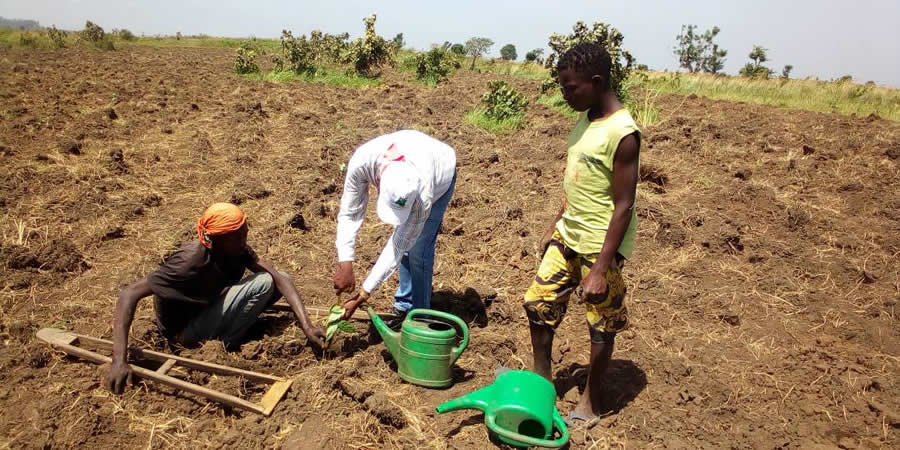
Mr. Ukelo Jonathan, Chairperson - FLEVICAA climate change activist volunteer demonstrates tree planting techniques to a farmer in Bunia.

Conclusion:

Protection of the environment is a priority area for all NBD membership and it is for this reason that FLEVICA spearheaded the celebration of the National Tree Day in Ituri province.   The event exposed participants to the effects of deforestation, climate change dynamics,  and  the benefits of reforestation. Each participant got the opportunity to plant a tree in celebration of the day and putting in action the lessons learned at the event.   As deforestation in the province of Ituri is already causing harmful effects to agriculture and the environment, awareness-raising activism is to be multiplied to reduce its effects but also contribute to community resilience to climate change dynamics.


About FLEVICA:

Fleuve D’eau Vive Qui Coule Aux Autres (FLEVICA) translated as River of Living Water Flowing to Others is a non-profit and non-denominational Community Development Organization based in Bunia, in the Ituri province DRC. FLEVICA is a member of the Nile Basin Discourse - subscribing through the DRC Nile Discourse Forum. FLEVICA exists to contribute to the fight against poverty, to raise the standard of living of the population and to promote inherent rights.
FLEVICA's activities are designed around nature, developing capacity of peasants, and fighting poverty through development initiatives at community level. Activities are in particular social reintegration, support for the revival of community work, the promotion of agriculture, environmental protection and food security.


Author:
Assingya Victor,
National Technical Support Expert - DRC NDF


Passenger service riders paddle through a flooded street in the city of Kigali, Rwanda. Source: Blogs.World Bank

Situation Update: The Impact of Flash Floods Disaster in Kigali City, Rwanda

Kigali in the recent past has experienced frequent and heavy rains and these have often led to flash flood. In the face of climate change, the increased frequency of such events threatens economic development. The City has suffered severe widespread flooding to major rivers, damage and loss of property, landslides, risk of loss of lives and livelihoods, and loss of public infrastructure.
Flood related disasters risk management has world over shifted emphasis from post disaster to pre-disaster phases. Pre-disaster flood management such as risk assessment, hazard identification, preparedness or preventive measures need detailed information about hazard characteristics, social-economic strength, and structural vulnerability and capacity. Such information is usually unavailable in many countries, as is the case in Rwanda.

The level of exposure to floods differs by locality. Even though some areas are highly prone to floods, the vulnerability differs from one area to another due to many factors. For example, the Eastern province is highly vulnerable due to the regular overflow of Nyabarongo River.

Highlights:

  1. Kigali in the recent past has experienced frequent and heavy rains and these have often led to flash floods. In the face of climate change, the increased frequency of such events threatens economic development. The City has suffered severe widespread flooding to major rivers, damage and loss of property, landslides, risk of loss of lives and livelihoods, and loss of public infrastructure.
  1. Torrential rains and flash floods have hammered several parts of the city and its outskirts consequently causing extensive power outages. The damage has been particularly acute in Kicukiro and Nyarugenge, the two major urban districts in the city. According to city authorities, Nyabugogo, one of the crowded market suburbs has been hit hardest due to the topography of its location and the lack of an efficient drainage system.
  1. Several streets and sidewalks got flooded and pedestrians had to leap over water to move around the city. The downpours triggered mudslides in some areas of Kigali city, damaging houses and roads. 
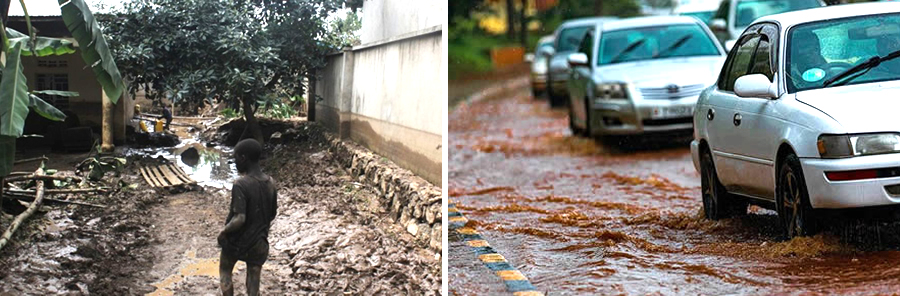
    Right - An ugly scene of a homestead in the aftermath of floods and left- motorcars wading through a flooded road
    Right - An ugly scene of a homestead in the aftermath of flash floods and left- motorists drive through a flooded road in Kigali City
  1. Beyond Kigali city, traffic was interrupted on some highways due to landslides across rural districts, according to police. Official reports indicate that over 3,100 hectares of crops were washed away by floodwater and 3,082 houses damaged, leaving thousands of families displaced.
  1. In consideration of other country zones, Climate change is bringing more irregular and unpredictable rainfall patterns with shorter rainy seasons to the largely rain-fed agricultural sector. While the meteorological department has warned that the rains being experienced after the dry spell will be above normal, communities in some zones are facing the danger of heavy floods and landslides. The situation may be worse for farmers whose crops will most likely be destroyed by floods at such a critical moment when the previous season was affected by the long dry spell.
  1. Ominously, the return of floods and landslides spells doom for thousands of families that are still trapped in high-risk zones across the country. According to the latest prediction, an increased amount of rainfall will likely result in floods and landslides in other 10 Districts namely Rusizi, Nyamasheke, Nyamagabe, Nyaruguru, Gisagara and Huye. Similarly, southern parts of Karongi, Bugesera, Ngoma and Kirehe districts are to experience more rains ranging between 150 to 200 milimetres accumulated in November 2022.
  1. Farmers, particularly, express fear that the rains could exacerbated the toll on the already dampened prospects for the year 2022 agriculture season now in the harvesting phase for staple crops like maize. The late and erratic rains, as well as a dry spell that characterized the season left farmers in both the southern and eastern provinces counting losses.
  1. A total of 64,840 farmers have been paying premiums under the State subsidized agriculture insurance scheme for the cover of 14,819 hectares of rice, maize, Irish potatoes, chilies and green beans in 2022 A season.
  1. Severe weather, including heavy rainfall, thunderstorms, and strong winds, in November 2022, have triggered floods and landslides across western Rwanda. Casualties and damages have occurred in Western provinces, with the worst-hit districts being Rubavu, Rusizi, Nyabihu, and Ngoroero. 15 people lost their lives and 37 others got injured in weather-related incidents across these districts, with seven fatalities and 26 injuries caused by lightning. Flooding and landslides have damaged around 130 homes in the region.

Interventions:

  1. The government has undertaken a flood risk assessment in Kigali City and has issued guidelines and advisories to citizens accordingly.
  1. The government has undertaken a flood risk assessment in Kigali City and has issued guidelines and advisories to citizens accordingly.
    Government interventions to mitigate floods disaster in Kigali city
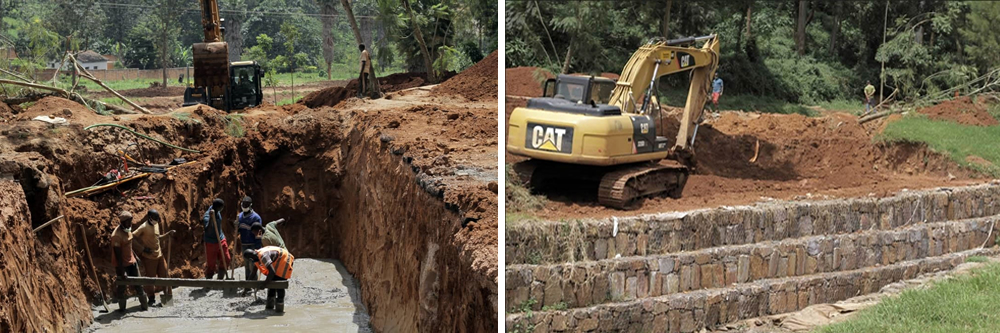
    Government has embarked on building new and widening existing water channels to mitigate floods disaster in Kigali city
  1. In order to mitigate the effects of flooding, the City of Kigali is building storm water channels, desilting water ways and relocating activities from wetlands; this is in the water catchment zones of Nyabugogo, Kanogo, Gisozi, Gikondo and Rwampara.
  1. Government has advised vulnerable spot settlers to relocate from these high-risk zones before disaster strikes.
  1. The population has been put on alert to monitor local media for weather updates and related advisories; to confirm all transport reservations and business appointments before travel.
  1. Citizens are also advised to make allowances for localized travel delays and potential supply chain disruptions where flooding has been forecast and to also avoid driving/riding on flooded roads.
Author:
Nzaramba Rene,
National Technical Support Expert - Rwanda NDF


Rabbit keeping at the home farm. Aside sales of their delicious meat, their urine is used as insecticide while the solid waste is manure to fertilize the home garden

Green Homes for Sustainable Development: Creating Climate Change Resilience in Slum Communities of Kampala - Uganda

In 2021, Nile Basin Discourse (NBD) with support from CIWA Program trained women and youth as Climate Change Resilience Champions; this training has created big impact. Asia Namusoke, one of the beneficiaries of the training shares her story; the training inspired her to diversify into small but smart innovations that are transforming households and specifically women and youth of her slum community in Kampala - Uganda.     ( Watch related video )
In September 2021, I was trained by the Nile Basin Discourse (NBD) as a Climate Change Resilience Champion and I am a proud advocate for Climate Change and Green Homes for Sustainable Development. The training inspired me to diversify into small but smart innovations that would transform households and specifically women and youth in my slum community of Ndejje Division in Kampala. Although I had convinced the trainers I would design a community program to support vulnerable youth and women living with HIV/AIDS in my community after the training, I didn’t know how to do it. When I visited Kampala Capital Authority Kyanja Agriculture Centre as part of the training activities, I was motivated. Their experience in empowering communities through provision of hands-on skills in sustainable agriculture was very inspiring.

I was challenged to think of Green Homes for Sustainable Development; the concept is to use environmental protection as a business to create an environment for socio-economic empowerment to address hunger, poverty, and mental health problems among slum dwelling women and youth. To address the challenges, I set up a demonstration income generating and environment-friendly project comprising of urban vegetables/spices garden, rabbit rearing, bee keeping, a waste recycling centre, and Black Soldier Fly rearing for alternative animal protein and high value crop fertilizer. The mission for the urban demonstration farm is to improve lives of women and youth in the surrounding communities, whilst contributing to the achievement of several SDGs localization. We work under a principle that the 17 SDGs are integrated—they recognize that action in one area will affect outcomes in others, and that development must balance social, economic and environmental sustainability..

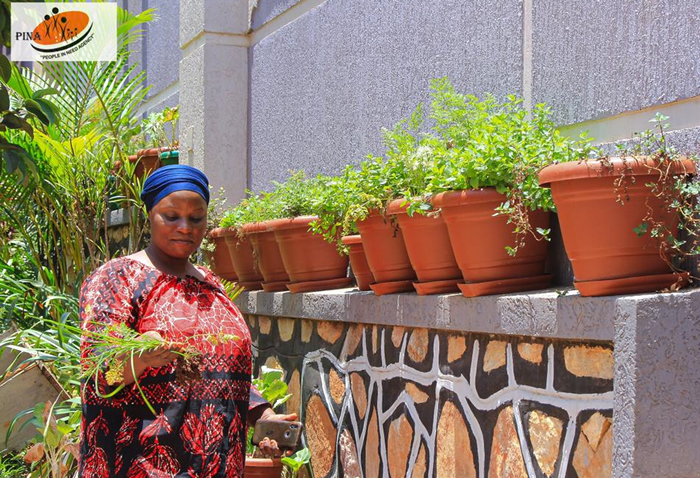
The variety of pot grown spices at the demonstration farm
The variety of pot grown spices at the demonstration home garden
The innovation is designed to strike a balance between therapeutic and profitable goals, which are the two key pillars of our Income Generating Project. Community members are engaged as waste collectors, project staff, marketing and sales, and are assisted to start project-related businesses in their homes and communities. This allows them to occupy their time, earn a living, learn skills, and also help with climate and environmental protection efforts whilst accessing quality mental health-care at People In Need Agency – PINA Uganda the organisation that I conceived several years ago. At PINA Uganda, we strongly believe that the poor play a key role in the improvement of their own living conditions and their participation is not only a right but also instrumental in achieving greater effectiveness of our projects. Within a period of 4 months, we have directly created impact to 6 families and indirectly reached over 30 families within the targeted community.

The innovation addresses the daily realities that predispose young people and women to developing mental illnesses. Poverty and hunger are key drivers especially in slum communities and we are addressing this through creation of income generating activities/green jobs to reduce vulnerability, hunger, environmental degradation, health calamities, and increase incomes and hope. The target population can have something to look out for. Community members also generate funds from the sale of their farm produce.

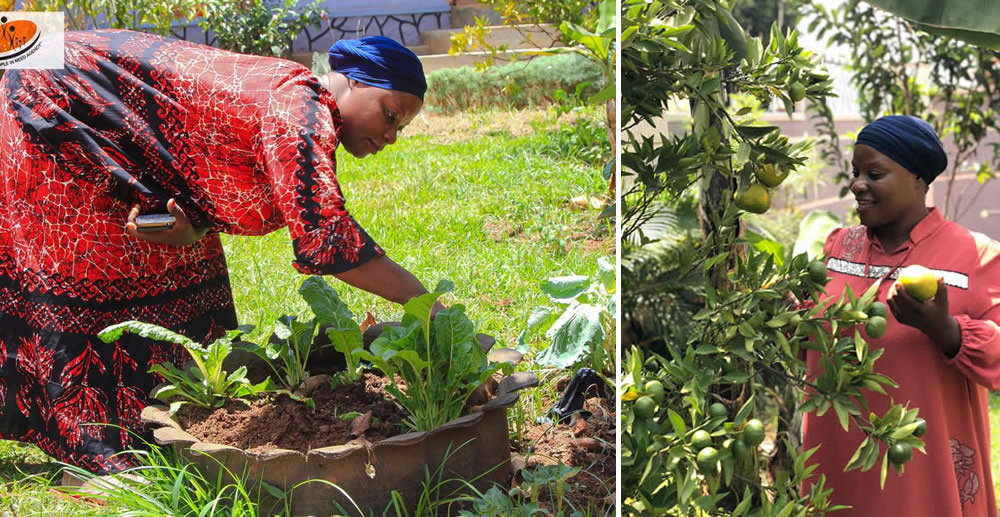
Harvesting vegetables and citrous fruits at the demonstration farm
Harvesting vegetables and citrous fruits at the demonstration home garden
The following are some of the activities we engage in;
  • Vegetables/spices/flowers/fruits demonstration gardens
    These demonstrate home garden technologies and offer hands on training to farmers in sustainable agriculture. The money generated from the sales of produce of the demonstration farm is used as capital to start other new businesses.
  • Training communities in Rabbit Rearing
    Profits from rearing rabbits comes in many ways: We sell the urine because many farmers use it as an insecticide, their waste is used as manure for fertilizer, and we sell rabbit meat whose demand is growing – it is a delicacy is several hotels and restaurants. It takes 70 days to raise a rabbit to reach market weight of between 3 to 10 Kgs. Waste from rabbits is also used to produce maggots that generate black soldier flies. These flies are used as top protein ingredients to feed other animals within the ecosystem e.g., poultry.
  • Training communities in Bee Keeping
    We keep bees that pollinate flowers, fruits and vegetables whilst increasing income from the sale of honey and wax. The extra income enables families to take care of their needs including healthcare.
  • Training communities on recycling and reuse of organic waste
    This innovation seeks to improve solid waste management and establish income generating projects from solid waste which would have otherwise been thrown away. Specifically, we educate the community on sorting of solid waste at the source of generation, recycling and reuse of inorganic waste, and on resilience measures by establishing income generation projects which can put waste to use; for example vermin- culture.

Key Recommendations and input into NBD/UNDF Programming as an Expansion Plan:

We are part of the Nile Basin Green Pilot Cities Project conceived as an outcome of the NBD/WB CIWA Project that trained us as Climate Change Resilience Champions across the country. We have started applying these proven best practices to engage women and youth groups in four cities of Uganda; Jinja, Fort portal, Gulu and Masaka. Our plan is to have demonstration and model villages in each of these cities under this Green Homes for Sustainable Development concept.
 
Our biggest gap is resources to expand but in order to get the resources, we are proud to participate in the profiling and documentation project under School of Public Health Makerere University for the right communication we need to reach our targeted partners.


PINA Uganda is a Not for Profit organization established in 2008, PINA works with vulnerable children such as victims of child sexual violence and children living with HIV/AIDS to elevate their standards of living; trains them to become social justice advocates and role models in their communities. PINA is a member of Nile Basin Discourse (NBD) directly subscribed to Uganda Nile Discourse Forum (UNDF).

Author:
Namusoke Asia,
People in Need Agency; Member of Uganda Nile Discourse Forum (UNDF)