TPL_YOOTHEME_SKIP_TO_MAIN_CONTENT
The climate change sensitisation team from Christian Faith International interfaces with the community during the visit

Civil Society Engendering Efforts to Address Climate Change in Grassroots Communities of Burundi

The sensitised communities committed to: i)Create market gardens to guarantee food security even in the face of drought ii)Promote large-scale irrigation coupled with the willingness to restore and protect water catchment areas iii)Engage in parallel but profitable income-generating activities with nutritional impact but not dependent on rainfall iv)Make rational management of rainwater, and v)Protect the green environment/vegetation through fighting against bush burning and deforestation..
Burundi is one of the 20 countries most vulnerable to the effects of climate change. Majority of the humanitarian needs in the country are caused by recurrent natural disasters linked to climate change. Since 2018, more than 445 natural disasters have happened; adversely affecting over 270,000 people in Burundi of which 100,000 were displaced.

Rising ocean temperatures are disrupting rainfall in many countries around the world and Burundi is not spared. The rainy seasons in Burundi are becoming more and more challenging to vulnerable populations.  Rain is a necessity for agriculture, but excessive or lack of it thereof is disastrous to nature.
Water and subsoil resources are essential for the economic and social development of the country. These resources are under strong pressure from the surging population growth, overexploitation of land, and the increasing demand for natural resources. Climate change and increase in its variability on addition to the above is further affecting the availability of water both in quality and quantity.

Kirundo province is one of the four provinces in the north of Burundi that, for more than a decade have experienced disruptions related to climate change; characterized by prolonged droughts resulting in chronic food insecurity. This situation of water deficit is attributable to global climate change due in part to excessive deforestation caused by demographic pressure and non-rational use of environmental resources.
Several hills in the north of Kirundo province, particularly those in the communes of Bugabira, Ntega, Marangara and Busoni, have not received rain for several months now, while the other communes have been hit by excessive torrential rains and strong winds, resulting in crop rot and damage to homes and infrastructure.

It is upon this background that on July 14, 2022, a civil society organisation Christian Faith International Burundi (CFI), which is also a member of the Burundi Nile Discourse Forum organized a community sensitisation visit to the construction sites of the Basic Schools of Carubambo - Ntega commune and  Ruhehe – Bugabira commune, both located within Kirundo province; first to assess the level of consideration and measures taken to protect the environment at the construction sites, but to also increase awareness about climate change adaptation, and conservation of the environment to the surrounding communities.

The team sensitised communities on climate change, its effects, mitigation, and adaptation – mainly focusing on drought and flooding. The communities were asked to control human activity on nature such as deforestation and overexploitation of the land which accentuates drought and the accelerates loss of water in the reserves. The activists appealed to the communities to take action while advising them on what to do to contribute towards climate change mitigation and also build resilience to climate change impacts.

The sensitisation focused mainly on behaviour change of members of the community in regards to the activities they do in their daily life, to align them with climate change mitigation actions since inconsiderate human activity is the leading contributor to climate change risks.
 
In response, the participants were appreciative of the sensitisation and committed to take all measures and advisories to mitigate impacts of climate change, protect the environment and build resilience to survive in the case of risks.
They committed to: - i) Create market gardens to guarantee food security even in the face of drought ii) Promote large-scale irrigation coupled with the willingness to restore and protect water catchment areas iii) Engage in parallel but profitable income-generating activities with nutritional impact but not dependent on rainfall iv) Make rational management of rainwater, and v) Protect the green environment/vegetation through fighting against bush burning and deforestation.


Initiatives by the Burundi government to mitigate climate change and its risks:

Various government initiatives are visible at the local level through the implementation of several climate change related disaster and risk prevention and management solutions. In addition to the creation of a precise map of risk areas, dykes are being built and buffer basins are being created upstream to mitigate the risk of overflow or waterlogging. The increase of green spaces is also ongoing as a means to minimize the occurrence and severity of floods in the long term.

Guidelines for the protection of highlands against erosion and cleanliness of flowing water were put in place by the concerned ministry and also endorsed by the Council of Ministers’ meeting held in early July 2022. The underlying reasons for developing these guidelines are:
  • There are many partners working in the field of environment but are not outputting expected results or causing impact on the ground
  • The vision of the government is that all such projects must be prepared in consultation with other partners and with observance and consideration of government plans and priorities.
  • The fundamental idea of the government of Burundi is that agriculture does not destroy the environment and that both complement each other.
  • A strict and cautious development on slopes of mountains and enhanced contouring of all the hills in the country so that the water in all rivers is clean and healthy.
  • Proposed projects must be accompanied with action plans of the activities that are environmentally friendly. The objective is that the mountain slopes and the rivers versant must be protected to conserve the environment.

Recommendations from the council of ministers:

  • The implementation of the guidelines should be carried out as soon as possible and protection of the environment must be a responsibility of all people.
  • The contour lines on hills should be created within this year (2022) regardless of who owns the fields.
  • The banks of the rivers that flow into Lake Tanganyika should be protected with bamboo trees.
  • The administration must contribute significantly in the implementation of these measures and the overall goal is that the water flowing in the rivers is clean and free from pollution.

Conclusion:

A combined effort of Civil Society, the government and all stakeholders in the fight against climate change, and the preparation of communities for climate change mitigation and resilience can have a far-reaching impact. CSOs have the capacity to effectively reach grassroots communities and to effectively influence appropriate action thereof. It is very important for both government and CSO to find common ground as they collaborate forces to enhance climate change action.

Author:
AHISHAKIYE Fabrice,
National Technical Support Expert - Burundi NDF


Building capacity of communities on creating and preserving Charco dams and using them for Drip Farming Technology on their farms

Participatory Floods and Drought Mitigation Interventions in Kishapu District -Tanzania

The project has demonstrated effectiveness of  interventions involving communities and civil society organizations as field partners. The partnership has now expanded to include Local Government and private sector networks in Kishapu and Kahama Districts. The project has also attracted the attention of donors and other NGOs in the country and as a result, Oxfam has contributed mobile sanitation facilities including mobile latrines to prevent the spread of water-borne diseases during floods.
Shinyanga Region has a tropical wet and dry or savanna climate with an  average  temperature of 23.34ºC which is -0.88% lower than Tanzania’s average. Shinyanga typically receives about 225.82 millimeters of precipitation and has about 232.46 rainy days in a year . According to the 2012 population and housing census, the district is projected to host 272,990 people (135,269 male and 137,721 female).

Relief to Development Society (REDESO) - a non governmental organization and member of Tanzania Nile Discourse Forum (TNDF), has been working with smallholder farmers in Kishapu since 2018 ,facilitating and supporting community responses to the extreme events of floods and drought through participatory research and promoting of promising practices at farm level to ensure food security.
Traditionally, local communities in Kishapu used to grow maize, beans and rice as the main food crops while cotton being the only cash crop.

Sudden flooding and prolonged drought have been threats to local livelihoods, forcing some households to migrate to other regions. REDESO is promoting adaptation to floods and drought through a Disaster Risk Reduction approach which includes popularizing crop diversification and integrated water resource management strategies.
Flood mitigation strategies include deep soil excavation to increase water absorption and neighbourhood charco dams. Drought mitigation strategies include the supply of drip irrigation tools and distribution of planting materials for drought resistant crops particularly cassava , sorghum and pumpkins as food crops and sisal as an additional cash crop.

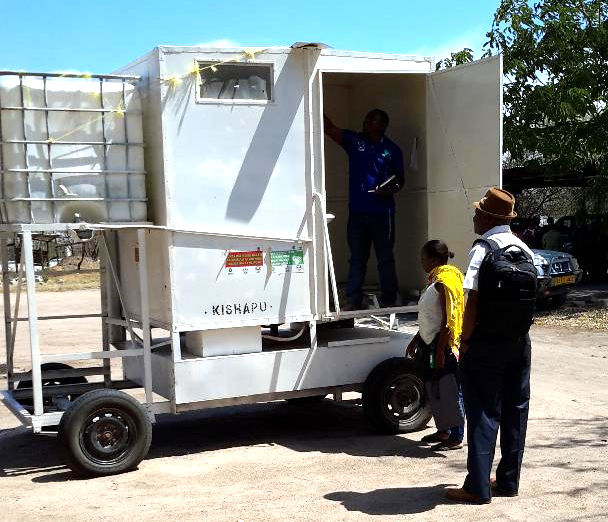
A mobile toilet made by REDESO to help victims during floods timesThe project started working with 21 groups and has currently scaled up to 95 groups (54 for women and 41 for youths).
Following the successes demonstrated through the project, the Local Government has come on board and has so far constructed 3 warehouses for storage of planting materials and contingency food stock.
The project has also attracted the attention of donors and other NGOs in the country . In 2021, Oxfam partnered with REDESO to replicate the project in Kahama District within Shinyanga Region. Oxfam has contributed mobile sanitation facilities including mobile latrines to prevent the spread of water-borne diseases during floods.


Success Stories:

A mobile toilet designed and made by REDESO in effort to help victims during floods timesThe project initiated by REDESO has demonstrated effectiveness of  interventions involving communities and civil society organizations as field partners. The partnership has now expanded to include Local Government and private sector networks in Kishapu and Kahama Districts.

Private sector networks in the two districts have supported the construction of more warehouses for day to day business which has gradually developed these places as marketing centres. The warehouses are gradually being stocked with general merchandise for the benefit of locals.

During an exchange learning visit organised by TNDF for women and youth groups to the project area, Mahuna Shigele, a resident of Kiloleli in Kishapu District, narrated:
“The Disaster Risk Reduction project is our baby. It was initiated through experiment and dialogue between villagers and REDESO. Our experts started documenting and sharing the century-old practices for flood and drought mitigation, blending them with modern science. The results are incredible. Kishapu and Kahama District Councils are now partners in the project  increasing extension and advisory support , with corporate sector contributing to infrastructural development .We do not consider floods as a threat any more, we can store the excess water and use it for drip irrigation during prolonged drought. Families are no longer thinking of migration since we have the right adaptive strategies.”


Challenges:

Preparedness is key in flood and drought mitigation, lowering the risks of loss of lives and properties. With the increasing uncertainties in the timing of the floods and drought, there is a call for establishment of an Early Warning System through collaboration with Tanzania Meteorological Agency. The system will be useful in alerting communities ahead of critical seasonal periods when floods are likely to set in. REDESO has started distributing mobile phones to Ward Disaster Committees as an initial step for information sharing in the districts. It is hoped that Tanzania Meteorological Agency will respond quickly and join the partnership for flood and drought mitigation in Shinyanga Region.


Conclusion:

The Disaster Risk Reduction initiative by REDESO is an excellent example of taming flood water for irrigation alongside other drought mitigation strategies. With climate change compounding the challenge of food insecurity in many areas of North Western Tanzania,TNDF and REDESO will use the lessons from Kishapu for advocating towards increased support to participatory flood and drought mitigation as well as establishment of early warning systems that are embedded into community governance structures


Author:
Hadija Malimusi,
National Technical Support Expert - Tanzania NDF


LEFT: Farmers participate in the bamboo farming sensitisation workshop.   RIGHT: Trainees receive bamboo seedlings to plant on their farms.

Promoting Bamboo Growing for Climate Change Adaptation, Resilience, and Livelihood Improvement in Kakamega County - Kenya

Bamboo is one of the fastest growing and highest yielding renewable natural resource contributing to economic growth of many countries across the world, including Kenya, although this potential is yet to be fully exploited in Kenya and many other African countries.
Kakamega County lies in the Western part of Kenya spanning an area of 3,051.3 KM2. Kakamega is boardered by Vihiga County to the South, Siaya County to the West, Bungoma and Trans Nzoia Counties to the North, and Nandi and Uasin Gishu Counties to the East. Kakamega county’s altitude is between 1,240 metres and 2,000 metres above sea level.

Environmental Degradation and its Effects in Kakamega County:

According to the County’s Integrated Development Plan (CIDP) 2018-2022, environmental degradation is mentioned as a major challenge to sustainable development. The main causes of degradation are indicated as pollution, deforestation, uncontrolled quarrying, poor land use practices, inefficient enforcement of environmental laws, and encroachment on gazetted forest land, hilly tops and slopes.

The combined impact of various forms of environmental degradation has led to adverse effects on the lives of people in the County including: declining water volumes/levels and drying of many springs and streams, unreliable weather patterns resulting into reduced farm yields, frequent flash floods and reduced land productivity due to loss of soil fertility - partly arising from leaching and soil erosion.

Relatedly, climate change has led to increased incidences and intensity of flooding, arising from modified climatic patterns, including increased precipitation during certain periods of the year. As a result, farming on the lower lands has been reduced due to regular destruction of crops when it floods, intensifying the already low food production in the county. Other effects include displacement of populations, poor quality water, and waterborne diseases.

Sensitization Workshop:

In a bid to address some of the environmental challenges in Kakamega County, the Regional Centre of Expertise – Western (RCE-W) organized a sensitization workshop on promoting bamboo growing for sustainable land management as well as water conservation. The workshop that was held in May 2022 and brought together 29 members of the community (mainly small-scale farmers) - representing more than 8 CSOs, most of whom are members of the Kenya Nile Discourse Forum (KNDF). The event was facilitated by Eco-Green Kenya – an NGO that focuses on promoting bamboo growing and its value chain for livelihood improvement, and climate change adaptation and mitigation under the Dutch-Sino East Africa Bamboo Development Programme.

The workshop aimed at sensitizing farmers on the importance and benefits of growing bamboo on their farms, and the current value chains in the bamboo industry for income generation.

Key highlights from the workshop:

  • Bamboo is one of the fastest growing and highest yielding renewable natural resource contributing to economic growth of many countries across the world, including Kenya, although this potential is yet to be fully exploited in Kenya and many other African countries.
  • Poles from bamboo had various construction uses – ranging from building shelters to fencing and scaffolding
  • Control of soil erosion – planted along river banks, bamboo has a high capacity to control erosion, as it has an elaborate root system that spreads wide and deep – thus holding soil particles firmly and preventing erosion. This reduces siltation of rivers, dams and lakes while also improving water quality – especially for domestic use
  • Purification ability – bamboo has natural filtering properties on water, including removal of chemical impurities. For this reason, it is recommended for wetlands to help purify water flowing through it into reservoirs.
  • The leaves from bamboo are good for use as mulch in organic farming, thereby helping conserve soil moisture, control weeds as well as improve soil fertility upon decomposition.
  • Source of Renewable Energy – bamboo was a good raw material for charcoal, whose use would reduce deforestation in natural forests. Its fast regeneration and growth rate make it a renewable source of fuel.

The following resolutions were reached:

  • Farmers whose farms bordered rivers/streams, and those on slopes/hills were encouraged to plant bamboo on the riparian sections and sloping land to prevent/reduce erosion.
  • A planned follow-up workshop will focus on basic training on practical aspects of bamboo growing including choice of species, propagation, spacing, pruning and harvesting.
  • Farmers to place orders for bamboo seedlings, as these would be delivered by Eco-Green in a few days. In the spirit of cost-sharing, Eco-Green would take on the costs for procurement and transportation of the seedlings, while the farmers would shoulder costs related to planting, protection and general care of the plants.
  • Extension service – Eco Green would continue supporting farmers who plant the crop through extension services and training.
  • Artisan Training for Value-addition – Youth and women interested in undertaking artisan training in value addition to bamboo products would be trained by Eco Green, upon request.
  • Farmers were encouraged to set aside a part of their farms for growing bamboo as a cash crop in order to tap into the growing potential for income generation through trading bamboo products.

Uptake of bamboo growing in Kakamega County will have many benefits, including:

  • Enhanced Climate Change Mitigation and Adaptation benefits through developing inclusive and sustainable industrial and bamboo value chains resulting in enhanced livelihood opportunities, food security and environmental management.
  • Improved water quality, thus reduced water-borne diseases in the community.
  • Creation of green jobs - especially for youth and women who would engage in establishing and managing of bamboo nurseries for income generation, artisans for bamboo furniture, weaving, handicraft, charcoal-briquettes making, and construction.
  • The overall benefits accruing to the Nile Basin include increased water volumes and quality, reduced resource-based conflicts, reduced siltation rates in rivers and Lake Victoria, as well as reduced loss of biodiversity arising from enhanced forest protection and enrichment with bamboo micro-forests.

Two important lessons stood out:

  • Participants learned that there was great un-exploited potential for bamboo farming, following the government’s decision to gazette bamboo as a crop through the Bamboo Act 2019. This opened opportunity for development of the crop through research and value addition; and farmers across the country would benefit immensely, if they engaged in farming bamboo. There exists both local and export market for bamboo products.
  • The Technical and Vocational Education Training (TVET) Directorate of the Ministry of Education has already rolled out a training programme on value chains and entrepreneurship in bamboo in pilot TVET institutions targeting the youth.

From the first sensitization meeting, farmers made requests for a total of 783 bamboo seedlings to plant on their farms. In this regard, Eco Green delivered and distributed 800 seedlings to the farmers on 27th May, 2022.

The Regional Centre of Expertise – Western (RCE-W) is a network of organizations implementing projects that contribute to attainment of Sustainable Development Goals, especially those relating to education and capacity building in matters of environmental conservation.
Author:
Tom Barasa Wafula,
National Technical Support Expert - Kenya NDF